Pets as Pioneers in Neurobehavioral Health Innovation
“In the cozy corners of our hearts, pets are the gentle whispers of comfort, reminding us that love and companionship can turn our darkest days into brighter tomorrows.”
Neurobiological Synchronization in Human-Animal Dyads
Research published in Frontiers in Psychology reveals synchronized cortisol patterns between humans and dogs during shared activities, indicating bidirectional stress regulation. This hormonal mirroring extends to oxytocin release, which increases by up to 30% during human-pet interactions, reducing anxiety and enhancing emotional resilience. Such findings underscore pets’ role as living biomarkers for studying autonomic nervous system responses, particularly in modulating sympathetic (fight-or-flight) and parasympathetic (rest-and-digest) activity.
Emerging research has revealed complex interbrain synchronization during human-animal interactions, providing deeper insights into the neurobiological mechanisms underlying these bonds.
For example, studies using electroencephalography (EEG) have demonstrated that mutual gaze and petting between humans and dogs induce synchronized neural activity in the frontal and parietal regions of the brain. These regions are associated with attention and social cognition, highlighting the profound impact of such interactions on both species. The synchronization strength increases with familiarity over time, suggesting that repeated bonding activities enhance neurobiological coupling, creating a leader-follower dynamic where humans lead and dogs follow during social exchanges. This phenomenon underscores how pets act as active participants in regulating human stress responses through shared neural pathways.
Interestingly, disruptions in this interbrain coupling have been observed in dogs with genetic mutations linked to autism spectrum disorders (ASD). These dogs exhibit reduced attention and impaired synchronization during human-dog interactions. However, experimental treatments using psychedelics like lysergic acid diethylamide (LSD) have shown promise in restoring interbrain connectivity and improving social behaviors. Such findings suggest that interspecies neural synchronization could serve as a biomarker for studying social impairments in ASD and other neuropsychiatric conditions. Such pieces of research open doors to novel therapeutic approaches that leverage the human-animal bond to address neurological disorders.
Moreover, rhythmic dyadic interactions across species further illustrate the adaptive benefits of synchronization. For instance, behavioral studies have shown that rhythmic signaling—such as mutual gaze or coordinated movements—enhances social cohesion, reduces stress levels, and facilitates joint attention. These interactions are not limited to humans and dogs but extend across taxa, including primates, birds, and mammals. By studying these rhythmic exchanges, researchers aim to uncover universal principles of social bonding that can inform both human psychology and animal-assisted therapies.
Clinical Efficacy of Animal-Assisted Interventions (AAIs)
Animal-Assisted Interventions (AAIs) represent a groundbreaking approach to mental health care, leveraging the unique bond between humans and animals to address complex psychological conditions. From alleviating posttraumatic stress disorder (PTSD) in veterans to reducing anxiety in pediatric patients, AAIs are redefining therapeutic paradigms. Recent research highlights how psychiatric service dogs and therapy animals not only provide emotional support but actively contribute to physiological and neurological regulation, offering measurable improvements in sleep quality, social functioning, and cognitive resilience. This innovative field is bridging the gap between traditional mental health treatments and holistic care, transforming lives through the power of the human-animal connection.
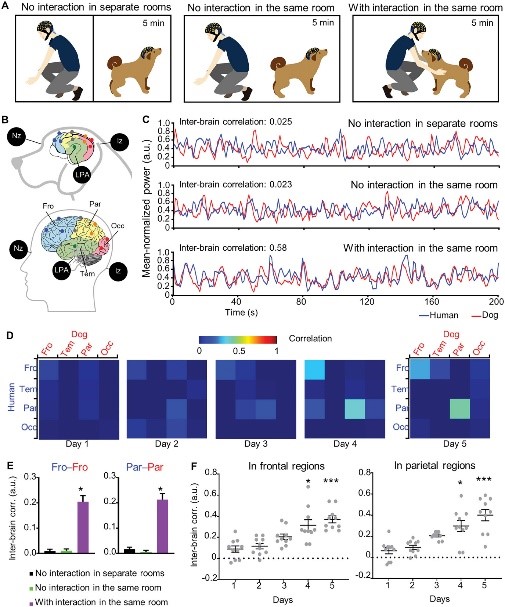
Interbrain activity coupling during human-dog interactions. A) Schematic of human-dog interactions (mutual gaze and petting): no interaction in separate rooms (left), with (right panel), and without (middle panel) interactions in the same room. B) Schematic of scalp electrode positions on dog brain (top) and human brain (bottom). The electrodes are color-coded (blue: frontal region; orange: parietal region; green: temporal region red: occipital region). Nz: the bridge of the nose; LPA: the left ear canals; RPA: the right ear canals; Iz: the little bump at the very back of the skull. C) Mean normalized EEG powers simultaneously recorded in frontal regions of dog and human on the fifth day of social interactions in three different conditions (no social interaction in separate rooms (top), in the same room (middle), and with social interactions in the same room (bottom)). D) Heat map of Interbrain activity correlations between socially interacting dogs and humans over five days. The color bar from blue to red indicates the correlation coefficient ranging from 0 to 1. Fro: frontal region; Tem: temporal region; Par: parietal region; Occ: occipital region. E) Interbrain correlation in frontal and parietal regions of dog (red) and human (blue) brain. *p < 0.05. n = 10. Error bars represent SEM. F) Interbrain correlation in frontal regions (left) and parietal regions (right) of socially interacting dog and human over five days. *p < 0.05, ***p < 0.001 compared with the first day, Friedman test. (Source: Science Alert)
• PTSD Management, and Symptom Reduction: Veterans paired with psychiatric service dogs exhibit 40% improved sleep quality and 25% higher employment rates, attributed to reduced hypervigilance and enhanced emotional grounding.
• Pediatric Anxiety and Pain Management: Controlled trials demonstrate a 32% reduction in pre-procedure anxiety levels among children interacting with therapy dogs during medical interventions.
• Cognitive Benefits: Longitudinal data associate pet ownership with a 15% increase in prefrontal cortex volume, linked to improved executive function and emotional regulation.
• Improved Social Functioning: Longitudinal studies reveal that veterans with service dogs experience a 50% improvement in social engagement and interpersonal relationships due to the emotional grounding provided by their canine companions.
• Neurological Impact: A PMC Study indicates that interactions with therapy animals stimulate the prefrontal cortex, leading to enhanced executive functioning and emotional regulation—critical for individuals recovering from trauma or managing chronic stress.
• Cortisol Regulation: According to Psychiatry.org, service dogs have been associated with normalized cortisol profiles in individuals with PTSD, suggesting their role in recalibrating the hypothalamic-pituitary-adrenal (HPA) axis for better stress management.
Mechanistic Insights from Comparative Models
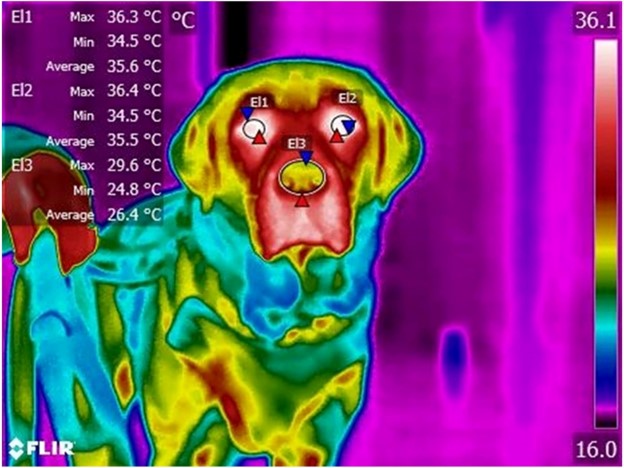
Assessment of signs of acute emotional states in dogs. The infrared thermographic image illustrates the positions of ellipses used to measure the surface temperatures of a dog's eyes and nose. The image features a Labrador Retriever captured with a FLIR T840 camera and analyzed using FLIR Tools software. E|1 indicates the ellipse positioned around the right eye, E|2 shows the ellipse around the left eye, and E|3 highlights the ellipse around the nose. The maximum, minimum, and average temperatures within these ellipses are presented as text on the image. (Source: Nature Briefing)
Comparative studies of dogs with separation anxiety reveal striking parallels in serotonin transporter (SERT) gene expression to human generalized anxiety disorder (GAD). Research shows that dogs exhibiting chronic separation-related behaviors display reduced SERT mRNA levels in the dorsal raphé nucleus—a key region regulating serotonin reuptake—mirroring findings in humans with GAD (Frontiers in Molecular Neuroscience).
This downregulation impairs synaptic serotonin clearance, leading to prolonged serotonergic signaling and maladaptive stress responses. Remarkably, early-life stressors in dogs, such as abrupt weaning or inconsistent caregiving, epigenetically modify SERT promoter regions, predisposing them to anxiety phenotypes in adulthood. These findings align with clinical data showing that humans with SERT polymorphisms exhibit heightened vulnerability to stress-linked psychiatric disorders, underscoring conserved molecular pathways across species (PubMed).
Feline HPA Axis Dysregulation and Chronic Stress Biomarkers
In cats, chronic stress induces hypothalamic-pituitary-adrenal (HPA) axis hyperactivity, characterized by elevated cortisol and disrupted glucocorticoid receptor (GR) expression in the hippocampus and prefrontal cortex. A longitudinal study found that cats exposed to unpredictable environments develop glucocorticoid resistance—a hallmark of human depression—due to GR downregulation, impairing negative feedback inhibition (Frontiers in Cellular Neuroscience). This dysregulation correlates with hyperactivity in the amygdala and reduced dendritic arborization in stress-modulatory brain regions, mirroring neuroanatomical changes observed in humans with PTSD. Pharmacological interventions targeting GR sensitivity in feline models, such as mifepristone (a GR antagonist), have shown promise in restoring HPA axis homeostasis, offering translational strategies for human therapies (WholisticMatters).
Cross-Species Pharmacogenomic Synergy
Comparative models highlight shared molecular targets for anxiety disorders. For instance, canine separation anxiety trials using SSRIs like fluoxetine demonstrate dose-dependent increases in hippocampal neurogenesis—a mechanism critical to antidepressant efficacy in humans. Simultaneously, feline studies reveal that omega-3 fatty acid supplementation normalizes HPA axis activity by reducing pro-inflammatory cytokines like IL-6, which are implicated in human mood disorders (Frontiers in Psychiatry). These synergistic insights are driving the development of dual-action therapeutics that modulate both serotonergic and HPA pathways, exemplified by novel drugs like zalospirone (a 5-HT1A agonist with GR-modulating properties).
Implications for Precision Medicine
The bidirectional translation between veterinary and human research is revolutionizing anxiety treatment paradigms. For example, genetic screens identifying SERT haplotypes in anxious dogs are now informing personalized SSRI regimens in humans, while feline HPA biomarkers guide cortisol-lowering therapies for stress-related disorders. Such cross-disciplinary approaches underscore the power of comparative models in bridging the gap between bench and bedside (AVMA Journals).
You May Also Like Canine Olfactory Sensitivity to Human Stress: Implications for Behavior and Welfare
• Resource Dissemination: With Lisa De Priest at the helm, her extensive experience in integrating therapy animals into clinical and workplace environments, ensuring their life-changing benefits reach those who need them most. PBN understands the importance of the profoundly inestimable caregiving exchange between pets, and humans. We leverages the best-in-class listing services and exclusive member benefits for an array of pet businesses, including Pet Wellness, Pet Grooming, as well as Pet Therapy Services, ensuring that every pet can contribute to our collective well-being and is also perfectly taken care of.
• Advocacy: Our memberships elevate businesses that shape/support pet-inclusive policies and those that recognize animals as vital contributors to emotional and physical health. We have exclusive listing categories for businesses like Pet Insurance Service providers, Veterinary Care Pet Services, Pet Providers and Clinics, and many more.
Connect with passionate pet businesses, engage a devoted audience, harness the benefits of SEO, SEM, events, and featured PR benefits from PBN’s comprehensive membership, and be an agent of change for a better world for animals at no additional cost; yes, a single PBN membership encapsulates it all. As a garden flourishes with care, your business can thrive with PBN’s resources and advocacy. Let’s sow the seeds of excellence and nurture an industry where compassion and commerce thrive harmoniously.
Join Pet Business Network today—because business for good is good for business, and together, we can make a difference.